

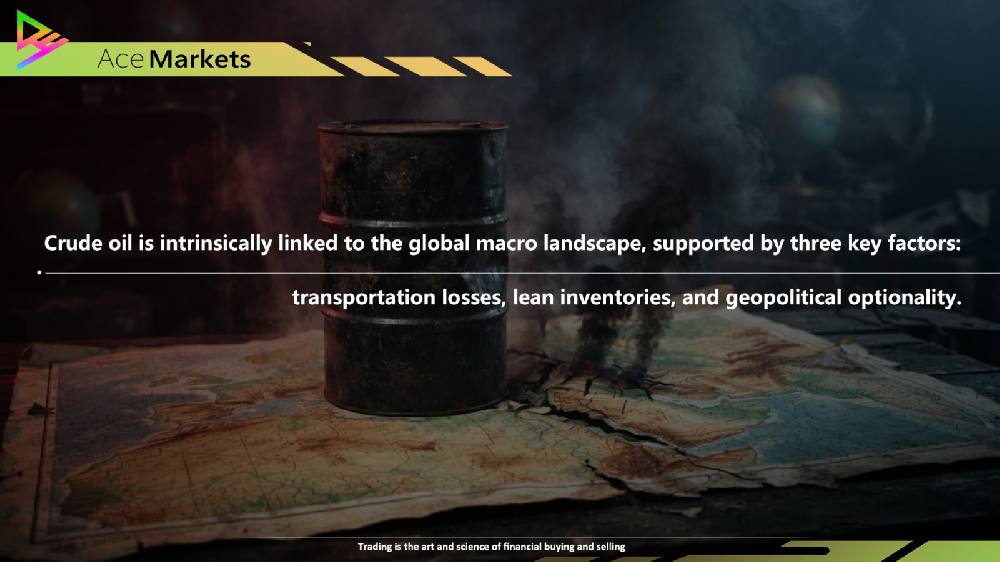
Exports have recovered to over 90% of pre-war levels, yet Brent crude oil is still nearing $108. The answer to this paradox lies not in oil field production, but in the triple resonance of transportation system inefficiencies, depleted inventory buffers, and geopolitical risk pricing. The shocks from the crude oil market are radiating outwards, becoming the underlying variable connecting US and European inflation, central bank decisions, and sovereign debt volatility; viewing commodities and macroeconomics in isolation will inevitably lead to biased judgments.
Structural surge in freight rates: Total capacity surplus, effective capacity becomes a rigid bottleneck.
The surge in freight rates is not a one-off risk premium from the Strait of Hormuz, but rather the result of five factors: a war risk premium of approximately $7 per barrel for passage through the strait, $4 per barrel for ship-to-ship transshipment, $4 per barrel for marine fuel costs, $3 per barrel for inefficient route diversions, and $2 per barrel for the reduction in available tankers for Iran. The global average cost of transporting crude oil has risen from $3 per barrel a year ago to over $20, with key Middle Eastern routes exceeding $35 per barrel.
The most perplexing aspect is that nearly half of the very large crude carriers (VLCCs) are empty, yet freight rates continue to soar. The root cause is a mismatch in fleet capacity – to avoid risks in the Taiwan Strait, a large number of tankers are forced to transship goods ship-to-ship, extending the round-trip cycle for VLCCs from 10 days to 23 days. While the total number of vessels hasn't decreased, the effective shipping capacity to respond promptly to refinery purchases has been significantly depleted, and the price increases have already spread to routes outside the Middle East. Macroeconomic evidence confirms this: even if supply from producing regions recovers, the rigid increase in distribution costs will still raise the floor for imported inflation globally. This is a major source of persistent inflation in the US and Europe, and also exacerbates the tightening pressure on the Federal Reserve and the European Central Bank.
Export recovery and price inversion: Three deadlocks hindering the transmission of supply to prices
First, the detours in logistics lead to rigid costs. Regular shipping routes have not been restored, and crude oil relies on pipelines, ferry transshipment, and shadow fleets for circulation. Coupled with ongoing attacks on Saudi Arabia's East-West oil pipeline and oil field facilities, the risk premium cannot be cleared quickly.
Second, extremely low inventories amplify price volatility. U.S. commercial crude oil inventories have declined for three consecutive weeks, and OECD oil reserves are at multi-year lows, effectively depleting the buffer. Even weekly disturbances of 5 to 10 million barrels can amplify oil price fluctuations many times over; this is based on the same logic as the low natural gas inventories in Europe.
Third, geopolitical shocks have shifted from immediate impact to option-based pricing. The market is simultaneously pricing in the possibility of further escalation after the US midterm elections, with events such as the evacuation of diplomatic personnel reinforcing risk expectations and building a solid floor for oil prices.
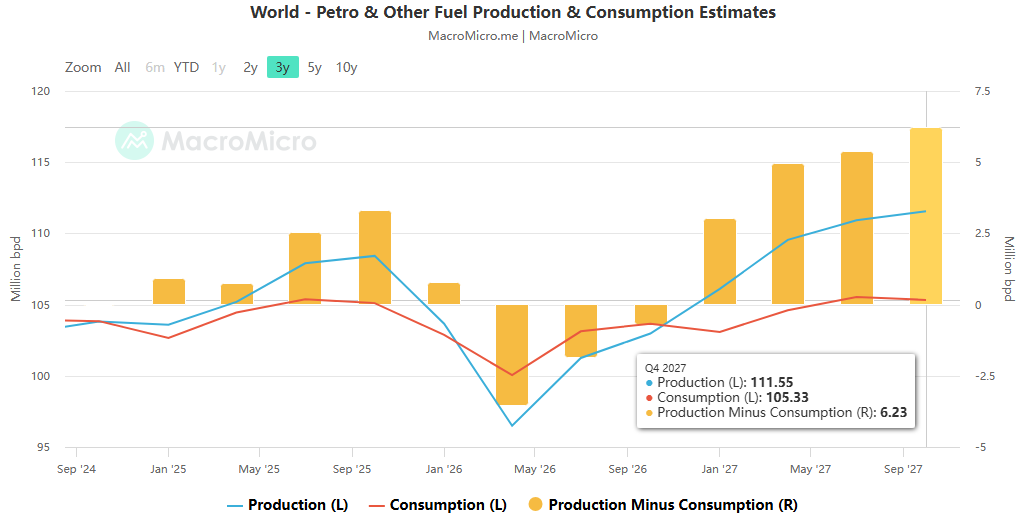
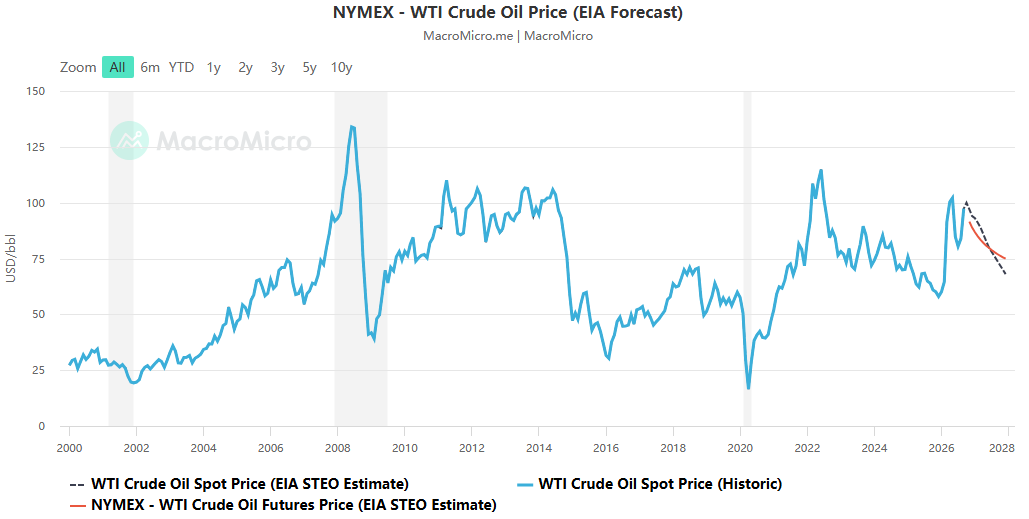
The divergence in institutional scenarios has reached an extreme: if the conflict de-escalates and dialogue begins, Brent crude may fall back to $74 per barrel in 2027; if the conflict continues throughout the year, it has the momentum to reach $130 per barrel.
Decoupling of benchmark oil prices from end-user prices: The second round of inflationary shocks in the refining sector
A decline in Brent crude does not equate to a decrease in end-use energy costs. As long as transportation and refining costs remain high, inflationary pressures will persist. Asian refineries are heavily reliant on long-distance crude oil imports and their facilities are designed for specific oil types. Switching to different oil types would reduce refined product yields; coupled with high freight costs, alternative sources may not be cost-effective. European refineries have already proactively reduced processing volumes, and Asian refining facilities are nearing their breaking-even point. This creates a negative chain: high transportation costs → refineries proactively reducing capacity → refined product prices rising against the trend, resulting in a misalignment where crude oil producers' profits are eroded by freight costs while end-use prices remain high. This aligns with the transmission logic of natural gas-electricity in Europe: upstream benchmark prices are only the starting point; logistics and processing will generate secondary shocks.
Cross-market linkage: Crude oil shocks connect the entire macroeconomic chain
For the US, rising freight costs are pushing up refined oil prices and exacerbating inflation stickiness, increasing the likelihood of continued interest rate hikes by the Federal Reserve. A cooling AI capital cycle leading to easing demand could partially offset this, but the two forces are pulling in opposite directions, putting the Fed in a dilemma. If oil prices surge again, even a decline in AI trading will not fully offset inflationary pressures, and US Treasury yields will face renewed upward pressure.
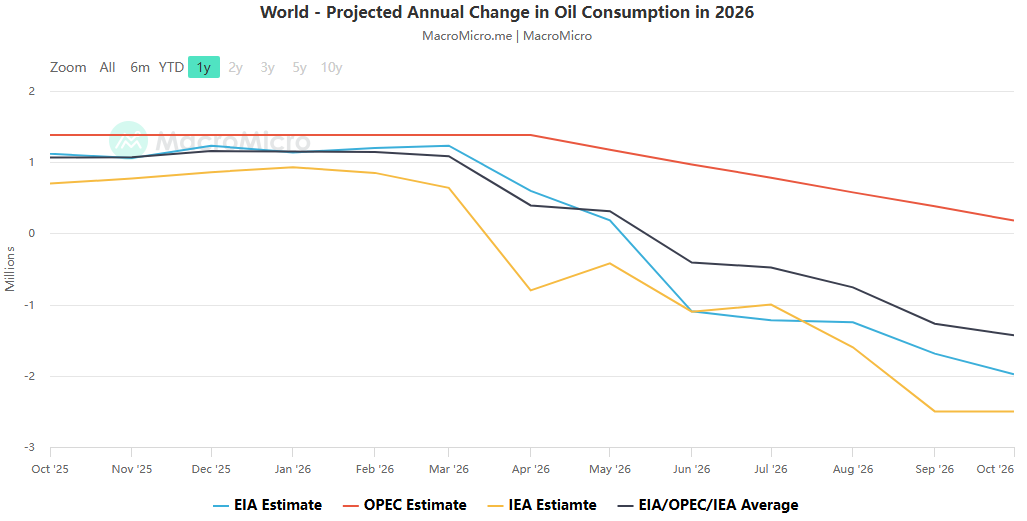
For the Eurozone, the dual energy shocks from refined oil and natural gas have pushed up overall inflation, forcing the European Central Bank to maintain a tight monetary policy. Persistently high interest rates have amplified the refinancing pressure on highly indebted countries such as France, widening the risk of sovereign debt spreads. Energy inflation and fiscal fragility have created a two-way negative feedback loop.
For asset pricing, transportation costs are reshaping cross-regional crude oil price spreads, with the Brent-WTI spread widening to $14 per barrel, far exceeding the normal $5. Trading opportunities are increasingly arising from relative arbitrage between regions and commodities, rather than simply betting on unilateral Brent price movements.
Most analyses only look at oil price charts or interpret central bank policies in isolation, failing to see how changes in the circulation end are transmitted along with inflation to sovereign debt, exchange rates, and equity markets.
Tracking signals and scenario simulation
Verifying supply chain recovery should not solely rely on Brent crude oil prices; three higher-priority signals should be considered: a sustained decline in global tanker freight rates, narrowing inter-regional crude oil price spreads, and stabilization of Asian refinery processing volumes. Only when all three are confirmed can it represent a substantial recovery in the transportation system.
Baseline Scenario – The conflict remains deadlocked, shipping costs fluctuate at high levels, inventories struggle to rebuild quickly, and oil prices remain in a high range. Energy inflation remains sticky, the Federal Reserve retains the option of raising interest rates this year, the European Central Bank maintains a tight stance, and the risk premium on Eurozone sovereign debt continues to be under pressure.
Upside risk scenario: Escalating attacks on Middle Eastern facilities and further disruptions to shipping could push oil prices towards $130. A full-blown rebound in imported inflation could force central banks in the US and Europe to tighten monetary policy further, leading to higher global long-term yields, amplifying the debt spiral risk in countries like France, and causing a systemic correction in risk assets.
Recovery Scenario – Geopolitical conflicts ease, shipping routes resume, freight rates decline rapidly, and refinery operations recover. Energy inflationary pressures are alleviated, tightening pressures from the US and European central banks ease marginally, and the global bond market gains room for recovery.
The real risks in the crude oil market are no longer limited to oil field production. Logistics losses, inventory shortages, and geopolitical option pricing are all contributing to the outward spread, profoundly influencing central bank policies, sovereign debt stability, and global asset pricing.